The conflict involving Iran is not only a military crisis. It is a maritime crisis, an energy-security crisis, and a test of the international system’s tolerance for coercion at a strategic chokepoint.
The Strait of Hormuz sits at the center of that exposure.
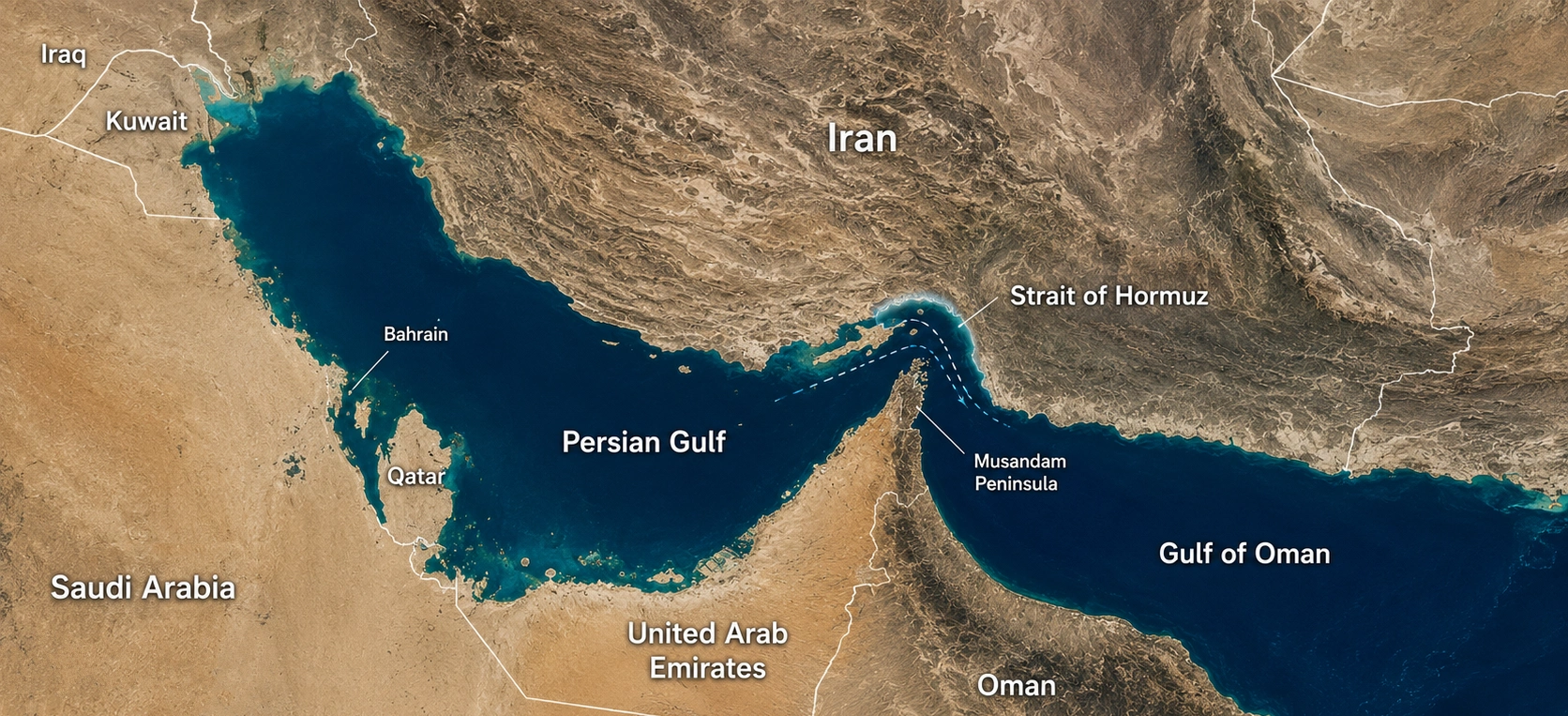
The strait connects the Persian Gulf to the Gulf of Oman and the Arabian Sea. A substantial share of global oil and liquefied natural gas moves through this corridor. Instability in the strait does not remain regional. It affects shipping schedules, insurance markets, naval posture, energy pricing, and the cost structure of global commerce.
Iran’s effort to impose fees on vessels transiting the strait raises a core question of authority. The Strait of Hormuz is bordered by multiple states and used for international navigation. It is not a private access route, a port facility, or a purely domestic waterway. Attempts to convert passage through the strait into a fee-based permission structure create immediate legal, diplomatic, and security concerns.
A distinction must be made between legitimate maritime administration and coercive control. States may charge for specific services in appropriate contexts, including port access, pilotage, navigation support, environmental services, or other concrete functions tied to actual delivery. Charging vessels for passage through an international strait is materially different. It reclassifies a shared route of international commerce into a controlled revenue point.
The security problem becomes sharper when the state demanding payment is also the state most capable of threatening, delaying, seizing, or attacking vessels that do not comply.
A vessel paying a “security” charge to avoid interference from the same actor generating the security risk is not purchasing protection from a neutral authority. It is paying the party positioned to make passage dangerous. The arrangement resembles coercion more than maritime governance.
Commercial shipping depends on predictability. A cargo vessel does not move through a strategic chokepoint as an isolated asset. It moves through a layered system of insurers, flag states, charterers, cargo owners, port authorities, naval forces, and financial counterparties. Once passage becomes conditional, each layer must reassess exposure.
Insurance premiums may rise. Transit decisions may change. Shipping may slow, reroute, or require escort. Energy markets may price in uncertainty before supply is physically interrupted. Governments may be forced to determine whether nonpayment by a commercial vessel is a private commercial matter, a national-security concern, or a test of freedom of navigation.
Hormuz carries significance beyond Iran because the strait converts tactical pressure into strategic consequence. A new transit fee, a boarding operation, a missile threat, a mine warning, a disputed permit requirement, or a naval escort requirement can all alter how global commerce reads the environment. Markets do not wait for full closure. They respond to credible risk, uncertainty, and the perception that rules are being rewritten under pressure.
The precedent is equally important.
If a state can threaten a shared maritime corridor and then monetize the reduction of that threat, other actors will study the model. The immediate case is Hormuz, but the broader template could extend to other chokepoints, ports, undersea infrastructure routes, and critical shipping lanes. The global commercial system depends on the assumption that essential transit routes remain governed by law rather than by the actor most capable of imposing cost.
This analysis does not require a pro-war conclusion.
Recognizing coercive maritime behavior is not an argument for escalation. Clear analysis reduces the risk of escalation by defining the problem accurately. Failure to distinguish lawful maritime regulation from coercive control increases the chance of miscalculation. Commercial vessels become instruments of geopolitical pressure. Insurance markets become early-warning systems. Naval forces become guarantors of commercial confidence. A regional conflict becomes a global logistics problem.
The Strait of Hormuz is a field of concentrated exposure.
It is geographic exposure because the corridor is narrow and difficult to replace.
It is economic exposure because energy and cargo flows through the strait affect global markets.
It is legal exposure because authority over international transit cannot be converted casually into a tolling regime.
It is security exposure because the actor proposing fees is also one of the principal sources of threat.
It is strategic exposure because concessions made under pressure can become templates for future coercion.
The central issue is not the existence of a fee in isolation. The issue is whether international commerce can be conditioned on payment to the party capable of disrupting it.
Hormuz is significant because it tests whether shared global routes remain governed by law, or whether access to them can be priced, pressured, and weaponized by the state with the nearest missile battery.